
Our regular Reviewer Tony Taft was unable attend the meeting this due to a prior commitment so our current President Chris Martin stepped in to fill the gap. Most members will know that Chris was a pilot and is thus able to add authenticity when commenting on all matters aviation.
Chris is currently preparing to take over the duties of Website Secretary at the next AGM.
Chris reports;–
Wednesday 02nd April at Paignton Probus was rather special, as we had, not one, but two presentations.
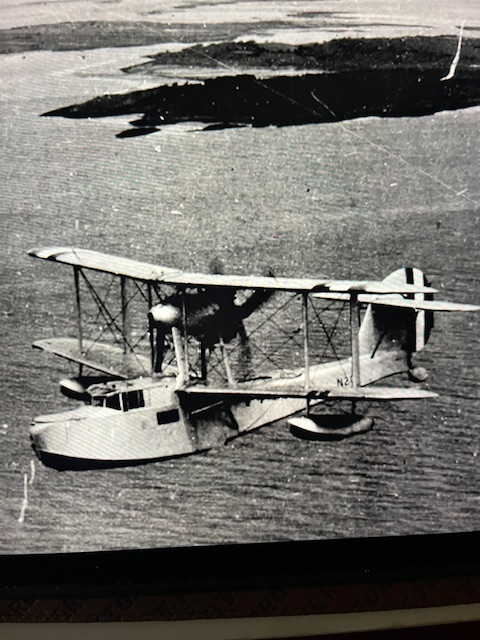
As you most of you know, Harding Jenkins had his funeral service in Paignton on Tuesday 01st April 2025. Rather sadly, having reached the great age of 95 years, he then had a fall which resulted in him passing away two days later.
He was a very keen member of Paignton Probus who was well liked by the membership, and as result, a large number of the membership attended his funeral service.
It was whilst at this service our Chairman Barry Ross, a keen model maker himself, found out from Harding’s son about the Walrus Model YouTube video, and later managed to obtained the link to it from Hardings son For any member who wasn’t at our meeting on the 02nd April, and who would like to see the videos made by Harding’s daughter-in-law Jaki , please click the “Play” button on the YouTube links below.
For those who were not present at our last meeting, or, are just interested, here is a little more information for you about the real, and rather rather special, little aircraft.
Built mainly as an air sea rescue aircraft, this biplane had, folding back / swing back, wings, this was so it took minimal space up when placed on a ship, note, not necessarily an aircraft carrier. To take-off the Walrus was placed on a catapult system, so didn’t need a runway, its single engine had a four bladed propeller fitted to it, and instead of being mounted on the front / nose of the aircraft, it was mounted on the back of the main wings, behind the pilot, so it pushed the aircraft, rather than pulling it through the air.
The real Supermarine Walrus MK 1 first entered service with the RAF in 1936, it remained in service with the Royal Fleet Arm until 1956, and during this period was credited with saving 10,000 lives at sea. Technical spec: It housed a crew of four and was powered by a 750 hp (later increased to a 775 hp) Bristol Pegasus V1 engine giving it a top speed of 135 mph, with a range of 600 miles, and a service ceiling of 18,500 feet.
In the video Harding explained in detail, how he overcame some of the difficulties he encountered whilst building this model of the Walrus, the engine being one of them. He then showed the completed model undergoing taxing trials in an outdoor swimming pool, which went very well.
I don’t think his model ever flew, but then having taken 30 years, Harding said, of on-off building it, I personally think that Harding was very wise not to try flying it.
Barry Ross informed us that Harding, who had previously given our Probus Group a talk on him building his first sailing dingy, had recently approached Paul Young offering to do another talk, Barry summed this up well I feel, by saying “well Harding now you have”.
**********************
Next was the programmed main talk of the day. This was given to us by a local man (well Torquay) who many of us already knew, Mr David Hinchcliffe.
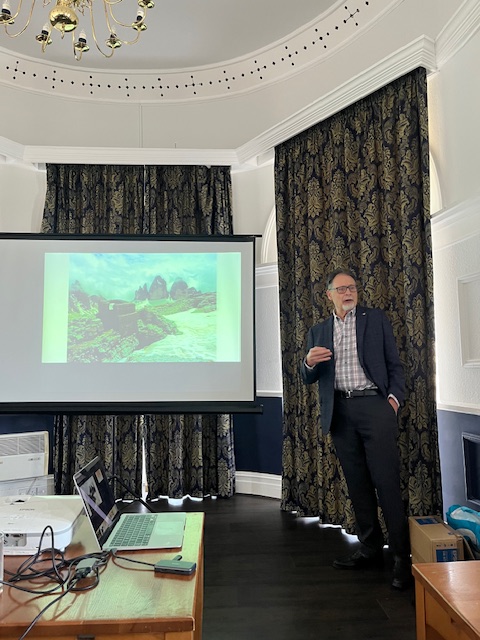
Mr David Hinchcliffe is an historian who likes to study and visit the sites of World War One great battles together with the war graves associated with these battles.
His presentation to us was entitled, ‘Camels Over the Alps’. Prior to the actual talk I had thought; Well, I suppose camels are used to cold conditions as well as hot, as it gets very cold (below freezing in fact at night) in the desert, also, walking on snow must be similar to walking on sand, hence their big feet would be ok. They carry / store water in their humps which would come in rather handy in the Alps, as it might not freeze, thereby proving a source of drink water for the officers evening whisky with water.
As some of you might have guessed by now ‘I’m only joking’ (Although, some of our group rather like fiction I believe).
His actual talk today was about the First World War, and in particular, the battle’s fought between the Austro-Hungarian and Italian armies for control of strategically important areas, such as the Monte Grappa massif, and covering the left flank of the Italian Piave front. The British were also drawn into fighting, supporting the Italians along this frontline, which ran across Northern Italy above Venice and followed the natural line of the river Piave, which it seems provided quite a difficult natural barrier to both sides.
Something of possible interest to us local Torbay residents is; at the battle of Caporetto (a big battle), which took place near to the towns of Padua and Verona, that this battle was lead by a Major / Lord Plummer, who’s family lived in a large Victorian Manor House situated on the top of the Lincombe Drive area of Torquay (apparently, it is still there with a blue plaque on the gate pillar, what’s more, it has not been turned into flats or a hotel, and is still a private dwelling.
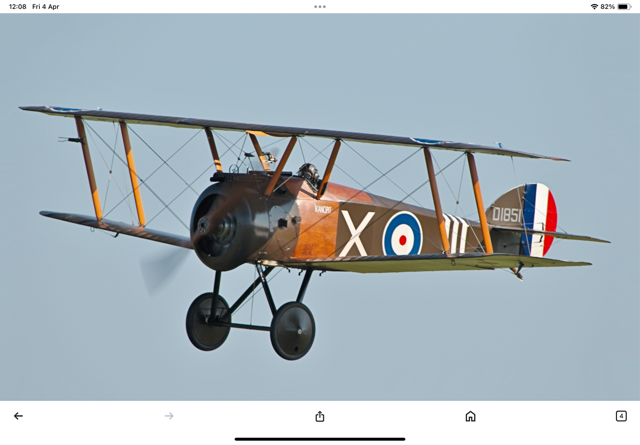
Getting back to the Camels; These were actually Sopwith Camels i.e. little single engined bi-planes used by the British, mainly for the purposes of aerial surveillance, plus, dropping the odd bomb (by hand over the side by the pilot), and dog fighting with the enemy aircraft.
The Italians put out a call for aerial reinforcements, and believe it or not, at this time the British had expanded they’re number of aircraft to 20,000, so were able to send three squadrons of Camel aircraft to assist.
These, ‘string bag bi-plane aircraft’ were not it seems very easy to fly. Firstly, they were open cockpit, rather cold for their pilots especially high up in the Alps, plus, they were fitted with rotary engines (not radial), this meant the multi cylinder engine actually rotated with / like the propeller did, which meant lots of torque roll to the right / starboard, which coupled with the aircraft having a rather small vertical fin and attached to it rudder, and the fact that the aircraft was not well balanced in that most of its weight was within the front end third of the aircraft, the pilot would certainly have had his work cut out keeping this aircraft straight and level. However, David told us that the pilot’s who didn’t lose control, then found ways in which to turn these disadvantages into advantages when involved in dog fights with the enemy’s aircraft.
Some other rather interesting facts regarding these Camel aircraft were that, the engine was lubricated by castor oil, which sprayed everywhere, pilots goggle’s were essential therefore, also, the engine didn’t have an exhaust system as such, the cowling around the engine captured the exhaust fumes and a section of it protruded out underneath the aircraft to release the exhaust fumes. Note: Sometime shortly after this period of 1916 – 1918, a company was formed, the name of which we all know today as ‘Castrol Oil’ Company.
David also told us, and showed us, a picture of a painting done in 1918, of a squadron of Camel aircraft flying over the Alps, at what he said was 20,000 feet! Those of us in the audience who had been pilots, or flight crew realised that this might not have been the case, as at 20,000 feet without a personal supply of oxygen these pilots would have been quickly rendered unconscious, then dead, so high, but not that high maybe.
Something David told us about, and in fact he showed us a photograph of, was to do with a pilot called Billy Barker, this gentleman was a Canadian Pilot attached to the Royal Flying Corps. It seems he was an ace who had shot down 30 enemy aircraft (recorded). But one day he was scrambled whilst in his bed, so he just put his flying suit on over his pyjamas and got airborne, he then later was involved in a dog fight over an enemy airfield. Unfortunately, Billy got shot down and captured (the photograph was of him captured), sitting still with only his pyjamas on under his flying suit. Being officers and gentlemen in those days, the enemy sent one of their aircraft over-head of one of our / an Italian airbase and dropped a note, which said he (Billy) had been captured, but that he only had his pyjamas to wear please send him some clothes, which it seems they did, dropping them from an aircraft onto a British or Italian airbase. A lovely story I feel.
David then showed us some of the photographs that he had taken whilst in this area researching information, both, out of interest, and for his talks. One of the pictures he showed us was of a very large and prominent war memorial at a place called ‘Mount Grappa’. The only Grappa that I had heard of before, is the name of the Italian alcoholic drink, which I have tried once and didn’t like much. However, this place was the scene of a very large battle in which 22,950 men lost their lives. After this war, the Italian leader Mussolini, is reported to have wanted to impress the young Italian men into joining the armed forces, an ‘honour and glory’ thing, so he commissioned the building of this very large memorial. Another very sad fact that David told us about was that during the course of the battle’s for Mount Grappa, only the names / identities of 2,950 soldiers were ever known, but the identities of 12,000 Austrians, and 10,000 Italian dead soldiers were never known. Therefore, the war cemetery and memorial at Monte Grappa has the bodies of 22,000 unidentified dead in it, that’s terrible I think, and to me it shows just how futile war is!
Thank you, David, for a really great talk.
 Paignton Probus Club
what a good review, lots of information, I have never used video clips in my reviews, I must try it sometime, great job. Tony Taft